Showing posts with label Fiber Arts. Show all posts

Tuesday, April 30, 2013

Rose Meditations

Rose Meditations


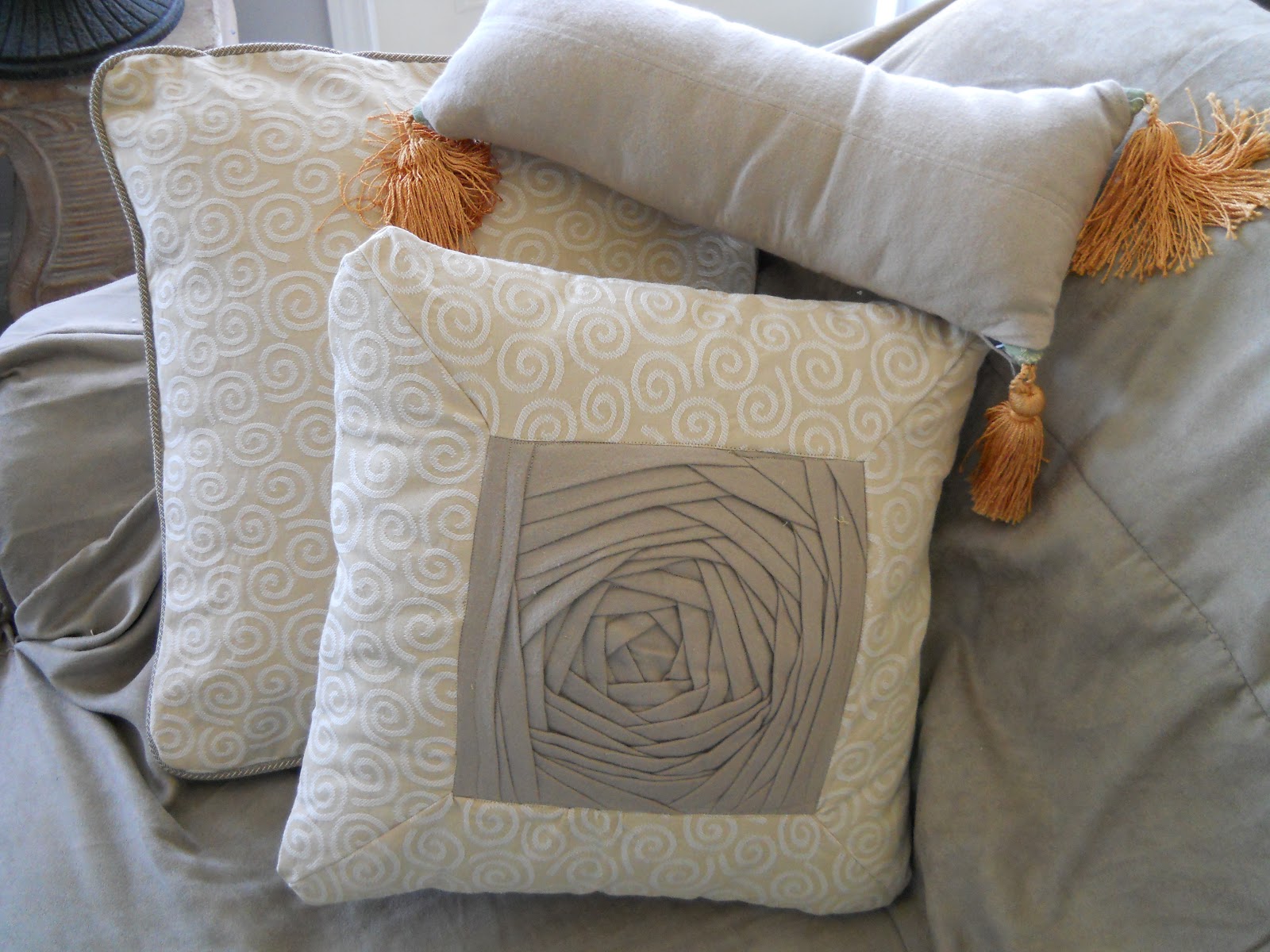
These Photos: 1) Making a rose throw pillow; 2&3) The throw pillows, finished; 4) An end table in the lady's restroom of a place I frequent; 5) A tile from a home show booth

The "recovering the chairs" project lead into the "making of throw pillows" project, which brought me back to something I've been writing in my notebook for a while.  I have different notebooks for different works in progress, one of which is for items I am designed to make with my own hands, household items or living items.  It's an obsession, something I do in addition to teaching and writing, to satisfy the ideas and images which come to me when I examine everyday objects and the way we live with them.

Depictions of roses interest me because they rely on repetition to build the flower motif in your mind.  Wether it is done in metal, clay, fabric, wood or frosting on a cake, the repetition of a certain shape, and the repetition of a certain action, adds up to the image of a flower.  The nature of a flower is to unfold, be it with two petals or a hundred, therefore repetition is also a design of nature.

When I had a bunch of leftover strips from making the chair covers, I knew I could use them to build a rose design.  I did not overly plan the design.  I started doing it, and as I did it, I lengthened the strips, let them overlap, let them be off-centered, until they filled out a square.  I suspect a real rose has more order to it.
This is a page from my creative ideas journal.  I keep this journal to jot down fabric and wood ideas, that is, things I think I can physically make.  This is an old page.  Roses have been on my mind for quite some time.

Saturday, April 27, 2013

Reclamation Satisfaction II

Reclamation Satisfaction II

The chairs both turned out nice.  The very last piece to be sewed was the bottom band.  The journey though, was a tough conglomeration of solving problems, dealing with angles, and correcting mistakes.

I shouldn't sew when I'm tired.  That is when mistakes happen, like this one.  Can you see it?
Sometimes, when involved with a project like this, I have to learn to work with a mistake instead of starting over, or tossing the piece.  In this case, tossing was not an option: I didn't have enough fabric to recut both seat bottoms.  I measured every piece of this project by hand, marked it with tailor's chalk and a yard stick, and cut each one in duplicate, to do each chair.  When it came to the seat pads, I thought I was being very careful, but I actually miscalculated, and cut each about 8 inches too wide.

To correct this error, I decided to add two pleats, right at the where the seat seam joins.  As it turned out, the pleat detail added interest to the monotony of the pattern, so I'm not disappointed with the detail.

I also had a lot of scraps left over so I decided to piece together some throw pillows.

Now, here is where it started to get interesting, and go a little bit wrong.

Here is where I have to acknowledge my obsessive behavior.  It happens when I'm editing manuscripts too.  It's like getting on a train, thinking you're going about twelve stops, realizing the train goes all the way across the country, then deciding to ride it to the end, just to get to the completion.  I don't know what type of compulsion that is, but I know I have it.  Sometimes I can plan for it.  I can not start a project which I think is a moderate-sized endeavor (usually, the projects I think are an hour end up being four, and the things I think take half a day end up taking two days, so, I've learned, through many late nights of having to meet my outer-world due dates, to double my estimates and check my available time) until I have an entire weekend.  There is a tug-of-war here though, because I also know that multiple attempts are needed at some projects, attempts which must be spaced over a week or a month, before a task, which might only take 8 hours, can be completed.  Students take note here: this is why you are given long dates to finish major assignments.  You can't just sit down the night before and knock it out.  

So, the next step was to finish the throw pillows, and some other seat covers, and that took an extra day, and it also lead me into an area I've been gathering in my notebook for a while: rose meditations.

Saturday, April 13, 2013

Reclamation Satisfaction

An old chair.  In this chair I have sat and watched sunsets, had good conversations with friends and loved ones, read many a book, cried some, and also had a good laugh or two.  It is a good chair, the perfect height for the bend of my knee, sturdy in frame, but tired at the seams.

I had a friend tell me once of all the things writers could do instead of writing.  He noted to me that a particular writer knew exactly how long it took to get a suit fitted, and that it was a favorite distraction.  Perhaps deciding to recover the chair is a distraction.  I don't know.  I can't do it all at once, at least not now.  I know how to cover a chair, knowledge not truly valued in the world of work and students, and because I know how to cover a chair, my mind can make all the architectural leaps necessary to adapt the craft of seaming, to the science of geometry and angles.  I just can't make them all at once, all those calculations and executions.  I can't dive in.  I'm also in the middle of writing something, and I can't do that from dawn to dusk either.  Why?  I can only stay inside the writing hut in my mind for so long, and then it becomes a prison.  I start to lose sense.  I look at the chair, know already the pattern piece required to uniformly cut the curve of each arm, and I know I must break down each task in covering the chair into chunks, and engage the process a chunk at a time.  If I stayed too long inside the world of covering the chair, it would be a prison too.  I would start to lose sense and make mistakes.  So, either recovering the chair is a necessary distraction from writing, or writing is a necessary distraction from covering the chair (two chairs actually--they're a set).

Why would one even want to attempt such a task?   Why not buy new chairs?  You would have to know me to understand why I don't give up on things, just because they show a little wear.  Perhaps it was being raised by two depression-era survivors, my aunt and uncle (maybe).  Perhaps it is because I'm too attached to objects (doubt it).  Perhaps it is that I enjoy puzzles and the challenge of walking into the unknown, and creating a bridge back to the known (my, my, we are rather proud, aren't we?).

Well, whatever the reason, I can't give up on an item with good bones.  How do I know it has good bones?  The chairs don't give in the frame when I move them, even after 30 years of being moved about.  This is something I learned from my uncle, who was skilled enough in carpentry to make his own cabinets.  A chair of this design, with the ledge of the seat protruding from the front (the armrest and the leg do not comprise one, straight piece), has a sturdy frame.  There's more wood in the frame, and more angles and braces supporting the entire structure of the chair, than there is in a chair of simpler design.  The fabric may give out on this chair, but the frame won't.

So, aside from liking the chairs, I've decided they are serviceable pieces of furniture that I will keep, and that will keep me.

First up, making room for a zipper in my slip-covers, so I can remove them and wash them when necessary.


The zipper will hit the back of the chair, center.

What is already apparent to me is that I have an idea about piping and the general look of the finished cover, even though I don't have a sketch of that idea.

And, this is where I am stopping for today.  Curves, ellipses, details, all floating in my mind, are left for the next day, the next session.

Thursday, August 9, 2012

The Persistence of Hand Made Objects

I inherited this bag after my Aunt Mimi passed away.  No one understood the significance of it, and it was probably going to go to Goodwill, however, I asked if I could take it, as a token of remembrance.

This is a shoulder bag which my aunt hand crocheted herself, during the 1970s.  It is chocolate brown and I believe it matched a pair of brown espadrilles she had purchased at J.J. Newberry's on Foothill Blvd., across from Sunland Park.  I am almost certain that she purchased this brown cotton crocheting thread from there, and probably the fabric for the liner, and the zipper, because I remember many times going with her to the fabric and notions department of Newberry's, which was located in the "basement" of the store.  (The store was actually split level, with an escalator in the middle, and the basement door on the back side of the store faced the daylight, and the cement roller skating rink at Sunland Park.)

My aunt was a champion crocheter, and knitter, as was my godmother, Elsie, and most of the Italian women on my father's side of the family.  When we visited my godmother at holiday times (Christmas and Easter) her furniture was covered with hand-made scarves and antimacassars.  Sometimes I thought there was a competition between these female relatives to see who could doll up their habitats, and themselves, the most.  This is why I remember this bag.

When my aunt slung it over her shoulder and took it with her to one of our "gone-a-calling" visits, one of our female relatives oo-ed and awed over it, commenting on how it resembled something she'd seen in a fashion magazine.  In my aunt's mind, I'm sure she thought "mission accomplished."

Beyond that though, during that period when fashion was very much out of reach to the middle class, and when a spirit of self-sufficiency prevailed (through the gas crisis, the unemployment crisis, soon to be followed by an international crisis in Iran), I'm sure, to my aunt, the fact that she could create of her own hand and within her own budget, the means to garner a type of respect from other women, was empowering.  I won't comment on capitalism and desire, and the way they tend to devour at the same time they seem to empower, because my aunt lived and died in a time before feminism really had its most meaningful impact on the lives of middle class women, whether those middle class women wanted to acknowledge it or not  (I believe this happened during the Reagan era, and even the post-Reagan era, when the acknowledgement of "the glass ceiling" occurred).

As a post-script to this post, I noted that in a recent issue of Vogue Magazine, a crocheted, Ralph Lauren bag was listed at retail for $995.  Definitely out of my reach.  I wonder if seeing this bag in a fashion magazine today would have inspired my aunt to update her creation, or begin again, in ecru.


Saturday, April 3, 2010

Fiber Artist, Julie Kornblum: Visually Delicious

Entwined Copper Midnight by Susan McGehee

Talking with Julie Kornblum, April 2010

Julie Kornblum is a fiber artist, a weaver, a mother, an eco-arts activist, and a featured artist in the 
Fiber 2010 show at the Studio Channel Islands Art Center. 
Her recent shows include: “Materiality” at ARC Gallery in Chicago; www.arcgallery.org; “Women’s Works 2010” sponsored by the Northwest Area Arts Council in Woodstock Ill, www.naac4art.org; and “ReVisions, New Creations from Scrap” at two locations in San Francisco, sponsored by SCRAP, www.scrap-sf.org. 
She has been awarded first place in the fiber art category in the Art Buzz 2010 competition, which was published in a hard bound book, www.artbuzz.org/book.html) . One of her woven wall pieces was awarded first place in the 2-D division in the 2009 Juried Member show at Studio Channel Islands.


LV:  There is a specific moment I've been interested in lately, a moment 
that is common across different artistic disciplines. It's that moment 
where action is taken on vision, the moment when imagination is no 
longer just in the mind, but is becoming manifest by doing.  I've been 
asking different artists, and different types of artists about this, the 
pleasure of doing, why it's pleasurable, how pleasure is perceived  


(through which sense organ--is it mostly visual?), and what it is  
about that particular moment that characterizes it as different from  
normal daily activity.  A task is being performed, but not a pedantic  
one.  It may be a repetitive task, but it may not be characterized as  
drudgery.


JK: I'm about ready to go into that place again.  I just finished a project 
and I'll be starting something new soon. I have ideas simmering on the 
back burner of my mind, about ready to boil over into doing, to make the 
idea a reality, sampling, playing with materials, working it out. 

I've been wanting all day to go into the dining room and sort materials
while I visualize the project I want to do next. The idea is hot, burning in
my head. It's the next one in the queue, it started to bubble closer to the
surface as I was coming to the end of the last project. its always this way.
I'll start thinking about the next thing as I'm finishing the current one.

Sometimes it's not pleasurable. It can be frustrating for days and weeks.
There can be technical issues, the materials don't work the way I want them
to. I try something, and try it a different way; it doesn't look how I
pictured it in my head, or it just doesn't look good to me. I walk away, I
leave it for the day or I have other tasks and duties in life to attend to.
the idea continues to percolate on the creative back burner. This is the
working-it-out phase. Its in between the vision and the actual doing.

On my circus piece, "Behind the Cotton Candy," this phase took almost six
months. for the yardage I just finished yesterday, the fused plastic gave me
a couple weeks of frustration.

After this stage there will be a moment, an aha moment when I know this is
it, this is what the project will be. Then I can begin. And this is a
pleasurable moment. I'll feel a sense of accomplishment, like the pleasure
of solving a problem - even though the project is far from being completed.
Sometimes I'm still far from the actual doing, since there is much
preparation of the materials ahead of me. Sometimes its also a huge relief,
like getting your car unstuck from the mud, and back on the road. This is
especially true when there's a deadline for getting the piece done.

The doing is enjoyable, very enjoyable. Sometimes it is so pleasurable that
people don't want to finish things. There can be almost a let down when
something gets finished. Maybe that's why I start thinking about the next
thing just before I've completed what I'm working on. Starting something new
is the most exciting part. 

LV:  Is the pleasure coming from what you're seeing, or is it derived from a 
different sensory input?

JK:  It is visual, yes, but it extends beyond that.  Sometimes when
knitting or weaving, I so love the colors and textures of the yarns I'm
working with; the pleasure of creation is from seeing them up close in my
hands. Sometimes its tactile on top of visual, the feel of the fabrics in
sewing, or the yarns in knitting and weaving. It is akin to eating a really
well prepared dish, a soup, cake, roasted chicken, bread, wine - whatever
does it for you; only you're taking it in with your eyes and finger tips.
It's that kind of enjoyment. When I'm really loving the work is when its
visually delicious.

There is also the pleasure of mastery. When I've joined the right technique
with the right materials, and it all comes together well, and I know I'm
making something of beauty; then that goes beyond the senses. Another
element is meaning. When I make something that looks great, and the
materials and technique support the concept and meaning I'm hoping to
communicate, then that's the ultimate. Is it a conceptual pleasure of the
intellect? It's mental and emotional. I don't know where it resides.

LV:  Do you still feel this if what you're doing is repetitive, like weaving?

JK:  The fiber arts do involve repetitive tasks, but they differ greatly from
daily tasks because as you repeat stitch after stitch, you are building
toward a finished product. As you weave, knit or crochet row upon row, you
are accomplishing something that can be completed. Daily household tasks are
maintenance, they can never be finished. You do the cleaning, cooking,
laundry, and soon your work is all undone and you have to start again. If
you clean your house every week for a year, you'll still end up with a dirty
house. If you knit or weave every week for a year you will end up with a
pile of textiles - garments, hand towels, art objects, whatever.  

More works by Julie Kornblum are visible at:


Julie Kornblum's work amazes me, because she uses re-purposed and found materials to weave traditional and non-traditional pieces.  The two works shown above are large-scale weavings, and both use plastic shopping bags.  That's amazing.