Showing posts with label The Writing Life. Show all posts

Tuesday, April 30, 2013

Rose Meditations

Rose Meditations


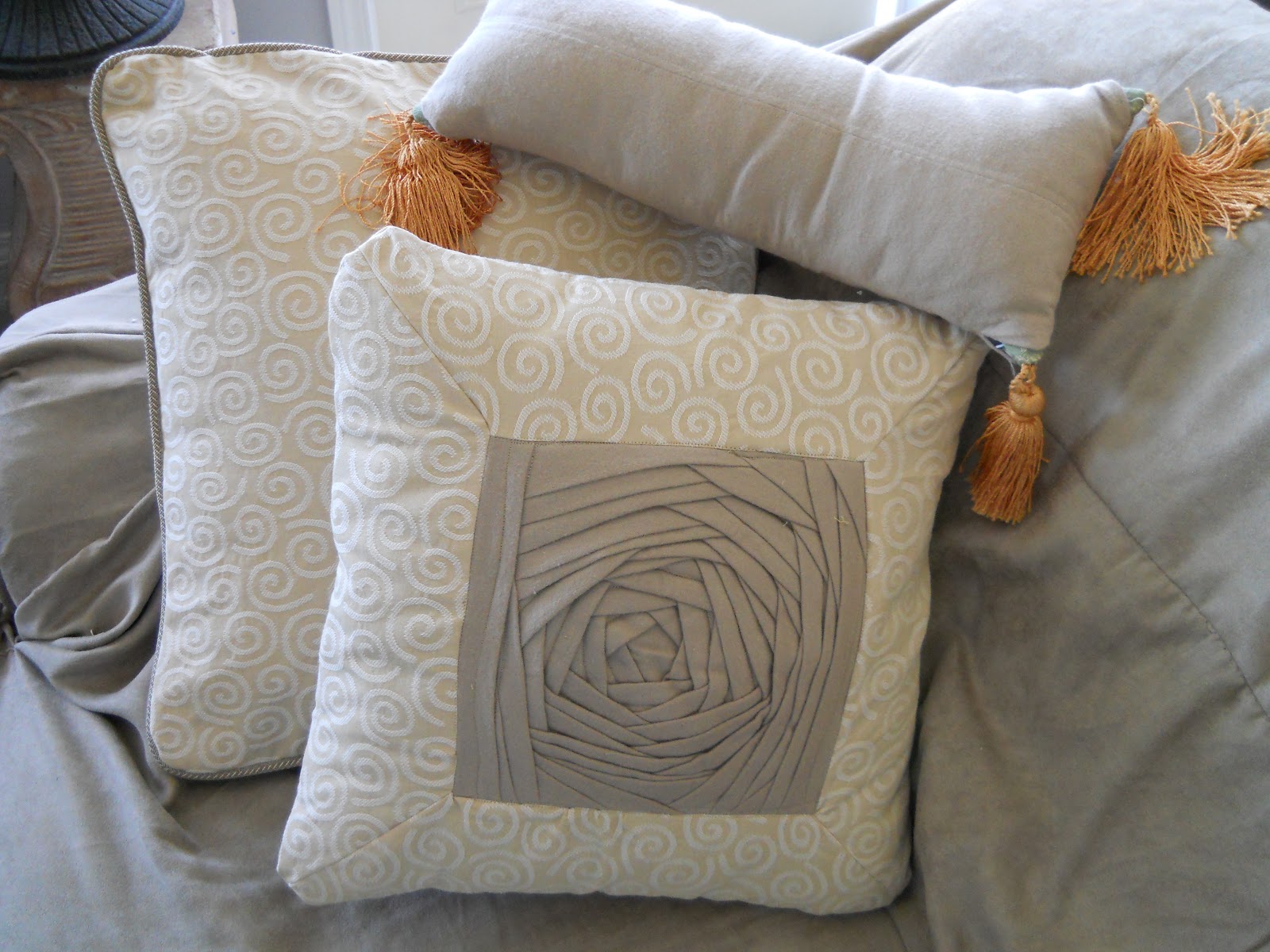
These Photos: 1) Making a rose throw pillow; 2&3) The throw pillows, finished; 4) An end table in the lady's restroom of a place I frequent; 5) A tile from a home show booth

The "recovering the chairs" project lead into the "making of throw pillows" project, which brought me back to something I've been writing in my notebook for a while.  I have different notebooks for different works in progress, one of which is for items I am designed to make with my own hands, household items or living items.  It's an obsession, something I do in addition to teaching and writing, to satisfy the ideas and images which come to me when I examine everyday objects and the way we live with them.

Depictions of roses interest me because they rely on repetition to build the flower motif in your mind.  Wether it is done in metal, clay, fabric, wood or frosting on a cake, the repetition of a certain shape, and the repetition of a certain action, adds up to the image of a flower.  The nature of a flower is to unfold, be it with two petals or a hundred, therefore repetition is also a design of nature.

When I had a bunch of leftover strips from making the chair covers, I knew I could use them to build a rose design.  I did not overly plan the design.  I started doing it, and as I did it, I lengthened the strips, let them overlap, let them be off-centered, until they filled out a square.  I suspect a real rose has more order to it.
This is a page from my creative ideas journal.  I keep this journal to jot down fabric and wood ideas, that is, things I think I can physically make.  This is an old page.  Roses have been on my mind for quite some time.

Saturday, April 27, 2013

Reclamation Satisfaction II

Reclamation Satisfaction II

The chairs both turned out nice.  The very last piece to be sewed was the bottom band.  The journey though, was a tough conglomeration of solving problems, dealing with angles, and correcting mistakes.

I shouldn't sew when I'm tired.  That is when mistakes happen, like this one.  Can you see it?
Sometimes, when involved with a project like this, I have to learn to work with a mistake instead of starting over, or tossing the piece.  In this case, tossing was not an option: I didn't have enough fabric to recut both seat bottoms.  I measured every piece of this project by hand, marked it with tailor's chalk and a yard stick, and cut each one in duplicate, to do each chair.  When it came to the seat pads, I thought I was being very careful, but I actually miscalculated, and cut each about 8 inches too wide.

To correct this error, I decided to add two pleats, right at the where the seat seam joins.  As it turned out, the pleat detail added interest to the monotony of the pattern, so I'm not disappointed with the detail.

I also had a lot of scraps left over so I decided to piece together some throw pillows.

Now, here is where it started to get interesting, and go a little bit wrong.

Here is where I have to acknowledge my obsessive behavior.  It happens when I'm editing manuscripts too.  It's like getting on a train, thinking you're going about twelve stops, realizing the train goes all the way across the country, then deciding to ride it to the end, just to get to the completion.  I don't know what type of compulsion that is, but I know I have it.  Sometimes I can plan for it.  I can not start a project which I think is a moderate-sized endeavor (usually, the projects I think are an hour end up being four, and the things I think take half a day end up taking two days, so, I've learned, through many late nights of having to meet my outer-world due dates, to double my estimates and check my available time) until I have an entire weekend.  There is a tug-of-war here though, because I also know that multiple attempts are needed at some projects, attempts which must be spaced over a week or a month, before a task, which might only take 8 hours, can be completed.  Students take note here: this is why you are given long dates to finish major assignments.  You can't just sit down the night before and knock it out.  

So, the next step was to finish the throw pillows, and some other seat covers, and that took an extra day, and it also lead me into an area I've been gathering in my notebook for a while: rose meditations.

Saturday, April 13, 2013

Reclamation Satisfaction

An old chair.  In this chair I have sat and watched sunsets, had good conversations with friends and loved ones, read many a book, cried some, and also had a good laugh or two.  It is a good chair, the perfect height for the bend of my knee, sturdy in frame, but tired at the seams.

I had a friend tell me once of all the things writers could do instead of writing.  He noted to me that a particular writer knew exactly how long it took to get a suit fitted, and that it was a favorite distraction.  Perhaps deciding to recover the chair is a distraction.  I don't know.  I can't do it all at once, at least not now.  I know how to cover a chair, knowledge not truly valued in the world of work and students, and because I know how to cover a chair, my mind can make all the architectural leaps necessary to adapt the craft of seaming, to the science of geometry and angles.  I just can't make them all at once, all those calculations and executions.  I can't dive in.  I'm also in the middle of writing something, and I can't do that from dawn to dusk either.  Why?  I can only stay inside the writing hut in my mind for so long, and then it becomes a prison.  I start to lose sense.  I look at the chair, know already the pattern piece required to uniformly cut the curve of each arm, and I know I must break down each task in covering the chair into chunks, and engage the process a chunk at a time.  If I stayed too long inside the world of covering the chair, it would be a prison too.  I would start to lose sense and make mistakes.  So, either recovering the chair is a necessary distraction from writing, or writing is a necessary distraction from covering the chair (two chairs actually--they're a set).

Why would one even want to attempt such a task?   Why not buy new chairs?  You would have to know me to understand why I don't give up on things, just because they show a little wear.  Perhaps it was being raised by two depression-era survivors, my aunt and uncle (maybe).  Perhaps it is because I'm too attached to objects (doubt it).  Perhaps it is that I enjoy puzzles and the challenge of walking into the unknown, and creating a bridge back to the known (my, my, we are rather proud, aren't we?).

Well, whatever the reason, I can't give up on an item with good bones.  How do I know it has good bones?  The chairs don't give in the frame when I move them, even after 30 years of being moved about.  This is something I learned from my uncle, who was skilled enough in carpentry to make his own cabinets.  A chair of this design, with the ledge of the seat protruding from the front (the armrest and the leg do not comprise one, straight piece), has a sturdy frame.  There's more wood in the frame, and more angles and braces supporting the entire structure of the chair, than there is in a chair of simpler design.  The fabric may give out on this chair, but the frame won't.

So, aside from liking the chairs, I've decided they are serviceable pieces of furniture that I will keep, and that will keep me.

First up, making room for a zipper in my slip-covers, so I can remove them and wash them when necessary.


The zipper will hit the back of the chair, center.

What is already apparent to me is that I have an idea about piping and the general look of the finished cover, even though I don't have a sketch of that idea.

And, this is where I am stopping for today.  Curves, ellipses, details, all floating in my mind, are left for the next day, the next session.

Thursday, January 3, 2013

Dear Rosaly


Rosaly,
 
I wanted to call you today many times, but I let myself be busy taking care of all the odds and ends, and of the dog.  I did get out and walk to the post office.  One of the blessings of being in this little, little town.  The post office is only a block away.
 
Tim continues to trooper on.  He has his second round of chemo next week.  He seems to be enduring them with only a few side effects, mostly fatigue.  He has a detached attitude about the body.  He shows me the hair leaving his body with a scientist's musing.  He might just have the right attitude about all of this to make it through.
 
We went to a chanting/meditation for New Year's Eve.  I don't know what was being chanted, but it was nice to slip into the rhythm of the syllables and just be with it.  It was a sanskrit text.  Then, a meditation until midnight.  It was clear, dark, and cold when we left.  It was like a midnight adventure.  Fortunately, it's only a few minutes from the apartment.
 
Tim's little white dog hurt her paw jumping off the bed last night, so today I was her nurse while Tim went to work.  Poor little puppy.  I had to carry her outside to go potty.  She just sort of looked at me with her little cloudy eyes and asked without saying.  I don't want to own any pets after this.  I don't like the constant reminder of what waits behind every green leaf.
 
It would be good to hear your voice.  I will call you Thursday or Friday.
 
I wish it were a short car ride to where you are.  I could come over for tea.
 
Much love,
 
Luisa
 
ps.  Have you seen this book "The pH Miracle" by Dr. Robert Young?  I'm wondering if alkalizing might help with the blood pressure. 

Thursday, September 30, 2010

The Terror of Going Within


            I used to hear writers talk about sitting down and “opening up a vein” and it used to fill me with a certain disdain.  I rejected that statement because it seemed self-indulgent, self-pitying, and melodramatic.  I wanted writing to be a joyous activity where I “brought forth” what was within me and it soared to artistic heights my body could not achieve.  I do still hold that aspiration, sometimes.
            There has been a terror for me though, a type of avoidance that is not like the productive avoidance I do when I busy myself with things which I bargain for internally.  (Things that I tell myself lead to writing, or need to be done so I can write, but which are not actually writing.)  These activities usually make me chuckle at myself, then I go to my desk like a petulant child (oops, I got caught) and I get to work.  The avoidance I feel lately though is different, darker, and it brings a different recrimination inside before I get to my writing. 
            It has to do with wasted time, or a distasteful chore.
            It’s not that what I’m writing at the moment is distasteful.  It is in fact something I signed up to do, volunteered for, suggested, pushed for, campaigned for, even at one point felt a great rush of adrenalin for.  It is my doctoral dissertation on poetry, drama, and opera.  I like the project.  I like the writing.  I like what I’ve written so far, and what I am now editing.  What I don’t like: the other eyes I feel over my shoulder while doing the work; the self-recrimination at not having finished sooner, for having invested my time in a collaborative project which didn’t pan out, the self-blame for having mismanaged my most valuable resources, my time and my talent.  It’s the litany of “should haves” repeating like a mantra in my head that terrorize me, panic me, and which I must overcome in order to finish this one particular project.
            As my significant other likes to say, “There’s nothing else for it.”

Wednesday, August 4, 2010

Getting Married Later in Life


June 5, 2010
Self Realization Fellowship Lake Shrine
Pacific Palisades


Everyone began the ceremony by first taking a peaceful walk around the lake.


Jordan liked having her picture taken.


Tim and I sat quietly while everything was prepared for the ceremony.  Brother Vishawananda blessed our rings.  When it was time to begin, the cameras were switched off.

It was a very serene day.


When Tim and I first began planning our wedding, we had a common thought:  How can we get our multitude of relatives to put aside their little squabbles and needs for hijacking family gatherings for just 24 hours?  The answer:  we couldn't.  

We took a very contemplative look at the list of people we were "supposed" to invite, the litany of brothers, sisters, aunts, uncles, cousins, each name also representing an ongoing dispute and entanglement with another name, and we sighed.  Instead of being a day where we solemnized our relationship and invited our loved ones to partake of the love we felt for each other, it was shaping up to be a day of running between camps and putting out fires.  That was not the tone we wanted to set for our marriage.  Both being in our mid-forties, we felt it was time to acknowledge that some things were just not going to change, and it was time to move forward.

There were five wedding guests at out wedding, and seven at our reception lunch.  Two of these people were our grandchildren, both under the age of four.  The monastic who conducted the ceremony encouraged us to enjoy the event, even little Benjamin, who was verbally delighted by the sight of swans outside the window of the windmill chapel.  Brother Vishawananda stated that even the sounds of a child laughing were part of the ceremony, part of the celebration of life.


Tuesday, April 20, 2010

Bears Read Poetry in Denver: AWP Annual Conference & Panel on Opera

April 2010

The best thing about the annual Associated Writing Programs conference is seeing people I haven't seen in years, and listening to what is new in the world of writing, small and university presses, and creative writing programs across the country.

The big highlight for me this year was not the panel presentation I was part of, but the one I attended on poets who write for opera.  This has been a passion of mine for a while now, and it is the main topic of my doctoral dissertation.

As Kate Gale noted, it is a small world, poets who work on libretti, but I would like to see that change.  As I look forward to the opening of Amelia at the Seattle Opera, with its libretto written by the poet Gardner McFall, and to the Rio de Sangre (Kate Gale & Don Davis) opening this fall at Opera Florentine, I'm encouraged that even in a period when most opera companies are scaling back their productions, these contemporary operas are still making it to the stage.

Adding an Inner Breast Pocket to a J Jill Blazer

I wear a lot of jackets and blazers, and I'm alway upset that 
they don't have breast pockets like a man's jacket or blazer.
I'm a writer.  I need to have a recorder (or a small notepad) 
and my cell phone on me all the time.

Why is that?  I carry an iphone and other gadgets, and I don't always carry a purse.  Why no nifty pocket to reach to inside my jacket?  (I used to think it was always so cool when 007 did that.)

My best guess at why manufacturers don't include this as a regular design feature (other than it adds cost) is that women like a good line to their clothing and we have breasts.  Many clothing manufacturers like to emphasis princess seaming for shape, but only high-end sportswear manufacturers find a way to make a shapely, functional garment with pockets.  Power walking is not the only time I need a reliable pocket.

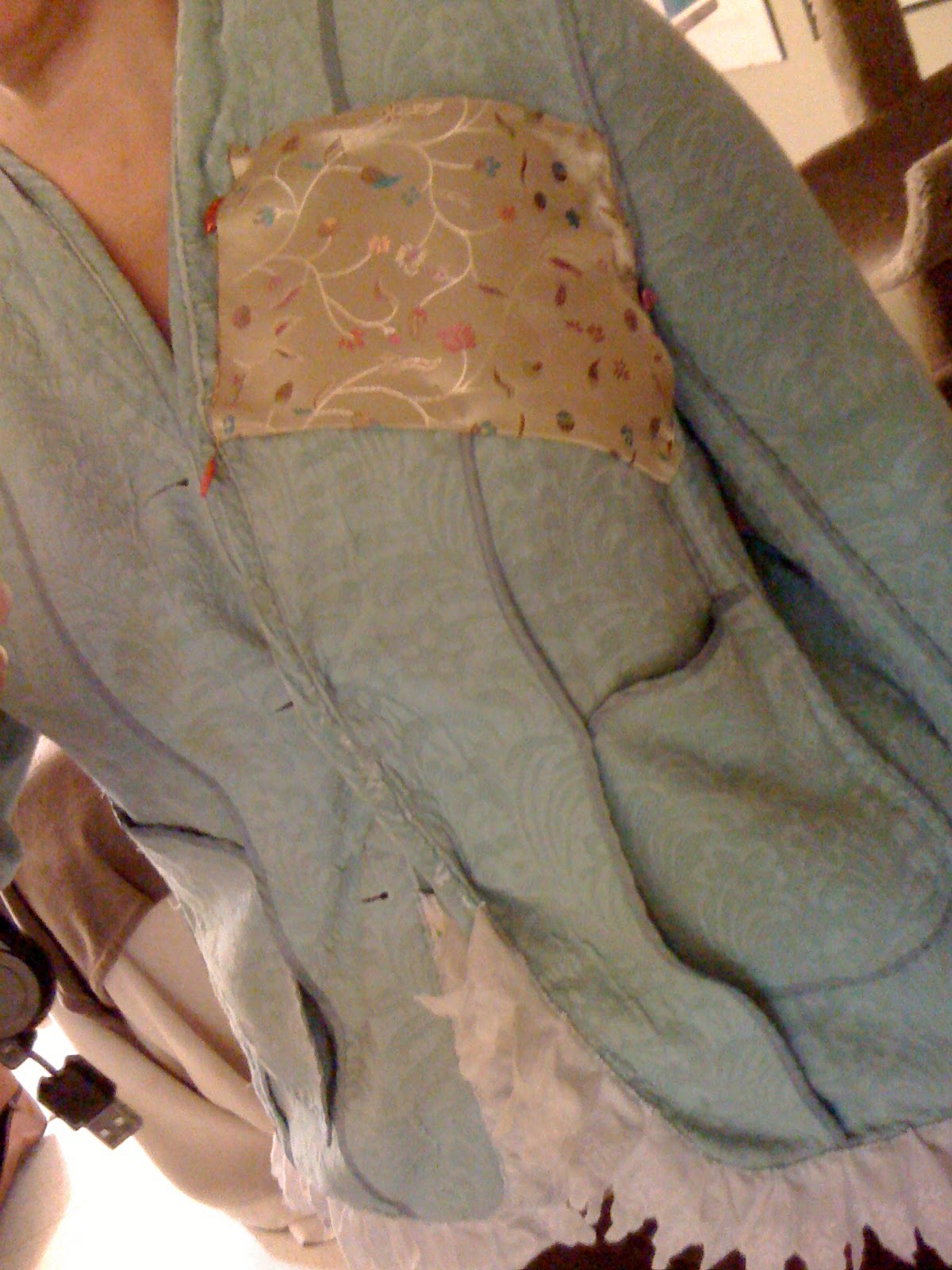
Usually I check the construction of jackets before I purchase them, to see if I can add my own pocket.  This J Jill jacket was a good candidate because even though it didn't have a lining, it had very nicely finished seams with added binding for strength.  That's a plus if you need something to anchor a cell phone pocket to.

I started by using some gridded quilt backing to trace the design of a pocket and see if it would fit to my jacket.  I put the jacket on wrong-side-out, and pinned the grid to the inside of the lapel, then marked where to cut it.  I wanted it to match the curve of the arm-hole in one corner of the pocket:


If you go back to photo #1, you'll see this shape will result in a pocket that is almost sideways, but which slants over the top of my breast toward my armpit.  I like this design because it keeps things from falling out, and it's easier to work with than a regular vertical pocket when sewing it to the jacket (especially if there's no lining to work with).


Here's the fusing pressed to my pocket fabric along a fold, and the pocket cut to match the fusing.


I sewed the pocket along the curved edge, the short edge, and the edge parallel to the fold, then turned it out and ironed it flat.


While wearing the jacket inside out, I pinned the pocket to the seams, then hand-sewed it to the armpit seam, the side seam, and along the seam of the lapel.  For extra support, I took a ribbon and anchored the pocket from its top to the shoulder seam.  The pocket opening is at the lapel seam and it holds my cell phone nicely.

Sunday, April 4, 2010

The Power of Repetition


Crochet a row.  Put it down.  Type on computer.  Repeat.

Virginia Woolf extolled the virtues of a country walk as a way to "rock oneself" back into writing.  The gentle swaying of a crib that she evoked in that statement, is the feeling I have when doing needlework, especially crocheting or knitting.  It is this actively calm rhythm which loosens my thoughts from the drive of delivering information, getting a point across, or thinking in a way that is outcome-based.

Beyond the repetitive motion which rocks me into a sentence, there is also a repetition in a sentence or a poem which pleases my ear.  In prose it is a careful assonance or alliteration which lets me know the writer wasn't just interested in delivering me from point A to point B, but that she intended to use the best language to get me there.  It might also be a phrase that comes back and increases the tension of the narrative through its repetition.


In a longer poem I might check the repetition of a key phrase and ask myself what purpose it serves.


The use of repetition can condense and unify visual scope

In Anne Sexton's poem "It Is a Spring Afternoon," there is a very long series of scenes, and a key scene of a girl outstretched on a tree limb.  After we are introduced to her for the first time, Sexton repeats  the phrase "Everything here is yellow and green."

.
This repetition acts as a gathering point for all the other images before the image of the girl, and the images after, to bring the landscape of the poem and its meaning into focus around the image of the girl and her naked body.

It Is a Spring Afternoon
by Anne Sexton

Everything here is yellow and green.
Listen to its throat, its earthskin,
the bone dry voices of the peepers
as they throb like advertisements.
The small animals of the woods
are carrying their deathmasks
into a narrow winter cave.
The scarecrow has plucked out
his two eyes like diamonds
and walked into the village.
The general and the postman
have taken off their packs.
This has all happened before
but nothing here is obsolete.
Everything here is possible.

Because of this
perhaps a young girl has laid down
her winter clothes and has casually
placed herself upon a tree limb
that hangs over a pool in the river.
She has been poured out onto the limb,
low above the houses of the fishes
as they swim in and out of her reflection
and up and down the stairs of her legs.
Her body carries clouds all the way home.
She is overlooking her watery face
in the river where blind men
come to bathe at midday.

Because of this
the ground, that winter nightmare,
has cured its sores and burst
with green birds and vitamins.
Because of this
the trees turn in their trenches
and hold up little rain cups
by their slender fingers.
Because of this
a woman stands by her stove
singing and cooking flowers.
Everything here is yellow and green.

Surely spring will allow
a girl without a stitch on
to turn softly in her sunlight
and not be afraid of her bed.
She has already counted seven
blossoms in her green green mirror.
Two rivers combine beneath her.
The face of the child wrinkles.
in the water and is gone forever.
The woman is all that can be seen
in her animal loveliness.
Her cherished and obstinate skin
lies deeply under the watery tree.
Everything is altogether possible
and the blind men can also see.



Saturday, March 27, 2010

Birth of a Poet


When I read poets and look forward to their next books, then that poet passes, it's like watching rope slip off a ledge, one I thought I'd tied firmly behind me, but suddenly--whoosh!--it's gone.  That sense of betrayal and disbelief at the empty air--it's like the moment you discover the person who you thought loved you, didn't really--a stripping-away moment.

I've been thinking of the opposite of that moment.  Wouldn't it be great to know the instant a new poet came into the world, to walk through a maternity ward and know that one of those callow faces was going to write the poem that someday, might save your sanity?  What a wonderful thing that would be.  It would be something like falling in love, but a little bit different, more like falling in awe, falling in limerence, being sublimely gobsmacked with gratitude.

Isn't that what happens when THAT book comes along?  I've had THAT book, the book that I can't bear to take out of my purse, the one I must have on me at all times, so I can read THAT poem, the one that looked right through me, the one that spoke my secret name.

I want more of those days.


In above photo: Nonna Luisa, Jordan

Wednesday, March 24, 2010

The Great Time of Saying Good-Bye

I am moving.
My inner dialogues have a flair for the dramatic.

Put these two things together and the result is what I have christened "The Great Time of Saying Good-Bye."

I get attached to places, to the confluence of time and space in my daily routines that produces a pattern.  As a writer I depend on these confluences to bring forth my writing self.  I have learned over many years that these confluences have to be actively created and nurtured by me in order for me to produce the work I want to produce.  If I leave things to chance, I won't get anything done.  Habit and environment are stronger than intention.

I get attached to places for this reason.  I spend a great deal of my imaginative life, or I spend a great deal of time in a place, imagining, and that repetition makes the place dear to me.  I get crushes on bushes, and benches, and fond wallpaper.

Tuesday, March 23, 2010

Catching Myself

Catching Myself in a Store Window
(Naturally, it's a bookstore.)

I once wrote a poem about things that hold our reflection without our consent, other people's sunglasses, water, television screens, etc.  A mirror, when you hold it in your purview, is like a conspirator.  You purposely use it to see yourself.  A store window though....

To see my own reflection juxtaposed in something else is sometimes jarring.  I was walking by a pawn shop in my poem, and seeing my reflection at the same time I was viewing worn objects made me aware of my own aging.  

It seems to me nature is one place I go to purposely not think about me.  Yet, on the entrance to the Wallis Falls trail:


...there I was.

I'm thinking about this more and more as I go down the path of being a blogger.  I've had people tell me blogging is about community, about connecting, but I wonder about the egocentric aspect of taking thoughts and making them public.  I don't have the same feel for these electronic words, nor quite the same tone, as my personal journal.  I'm aware of some aspect of performance here, or presentation, and of a need to be courteous, a need to self-censor.  Is that an accurate reflection of me?
Showing posts with label The Writing Life. Show all posts

Tuesday, April 30, 2013

Rose Meditations

Rose Meditations


These Photos: 1) Making a rose throw pillow; 2&3) The throw pillows, finished; 4) An end table in the lady's restroom of a place I frequent; 5) A tile from a home show booth

The "recovering the chairs" project lead into the "making of throw pillows" project, which brought me back to something I've been writing in my notebook for a while.  I have different notebooks for different works in progress, one of which is for items I am designed to make with my own hands, household items or living items.  It's an obsession, something I do in addition to teaching and writing, to satisfy the ideas and images which come to me when I examine everyday objects and the way we live with them.

Depictions of roses interest me because they rely on repetition to build the flower motif in your mind.  Wether it is done in metal, clay, fabric, wood or frosting on a cake, the repetition of a certain shape, and the repetition of a certain action, adds up to the image of a flower.  The nature of a flower is to unfold, be it with two petals or a hundred, therefore repetition is also a design of nature.

When I had a bunch of leftover strips from making the chair covers, I knew I could use them to build a rose design.  I did not overly plan the design.  I started doing it, and as I did it, I lengthened the strips, let them overlap, let them be off-centered, until they filled out a square.  I suspect a real rose has more order to it.
This is a page from my creative ideas journal.  I keep this journal to jot down fabric and wood ideas, that is, things I think I can physically make.  This is an old page.  Roses have been on my mind for quite some time.

Saturday, April 27, 2013

Reclamation Satisfaction II

Reclamation Satisfaction II

The chairs both turned out nice.  The very last piece to be sewed was the bottom band.  The journey though, was a tough conglomeration of solving problems, dealing with angles, and correcting mistakes.

I shouldn't sew when I'm tired.  That is when mistakes happen, like this one.  Can you see it?
Sometimes, when involved with a project like this, I have to learn to work with a mistake instead of starting over, or tossing the piece.  In this case, tossing was not an option: I didn't have enough fabric to recut both seat bottoms.  I measured every piece of this project by hand, marked it with tailor's chalk and a yard stick, and cut each one in duplicate, to do each chair.  When it came to the seat pads, I thought I was being very careful, but I actually miscalculated, and cut each about 8 inches too wide.

To correct this error, I decided to add two pleats, right at the where the seat seam joins.  As it turned out, the pleat detail added interest to the monotony of the pattern, so I'm not disappointed with the detail.

I also had a lot of scraps left over so I decided to piece together some throw pillows.

Now, here is where it started to get interesting, and go a little bit wrong.

Here is where I have to acknowledge my obsessive behavior.  It happens when I'm editing manuscripts too.  It's like getting on a train, thinking you're going about twelve stops, realizing the train goes all the way across the country, then deciding to ride it to the end, just to get to the completion.  I don't know what type of compulsion that is, but I know I have it.  Sometimes I can plan for it.  I can not start a project which I think is a moderate-sized endeavor (usually, the projects I think are an hour end up being four, and the things I think take half a day end up taking two days, so, I've learned, through many late nights of having to meet my outer-world due dates, to double my estimates and check my available time) until I have an entire weekend.  There is a tug-of-war here though, because I also know that multiple attempts are needed at some projects, attempts which must be spaced over a week or a month, before a task, which might only take 8 hours, can be completed.  Students take note here: this is why you are given long dates to finish major assignments.  You can't just sit down the night before and knock it out.  

So, the next step was to finish the throw pillows, and some other seat covers, and that took an extra day, and it also lead me into an area I've been gathering in my notebook for a while: rose meditations.

Saturday, April 13, 2013

Reclamation Satisfaction

An old chair.  In this chair I have sat and watched sunsets, had good conversations with friends and loved ones, read many a book, cried some, and also had a good laugh or two.  It is a good chair, the perfect height for the bend of my knee, sturdy in frame, but tired at the seams.

I had a friend tell me once of all the things writers could do instead of writing.  He noted to me that a particular writer knew exactly how long it took to get a suit fitted, and that it was a favorite distraction.  Perhaps deciding to recover the chair is a distraction.  I don't know.  I can't do it all at once, at least not now.  I know how to cover a chair, knowledge not truly valued in the world of work and students, and because I know how to cover a chair, my mind can make all the architectural leaps necessary to adapt the craft of seaming, to the science of geometry and angles.  I just can't make them all at once, all those calculations and executions.  I can't dive in.  I'm also in the middle of writing something, and I can't do that from dawn to dusk either.  Why?  I can only stay inside the writing hut in my mind for so long, and then it becomes a prison.  I start to lose sense.  I look at the chair, know already the pattern piece required to uniformly cut the curve of each arm, and I know I must break down each task in covering the chair into chunks, and engage the process a chunk at a time.  If I stayed too long inside the world of covering the chair, it would be a prison too.  I would start to lose sense and make mistakes.  So, either recovering the chair is a necessary distraction from writing, or writing is a necessary distraction from covering the chair (two chairs actually--they're a set).

Why would one even want to attempt such a task?   Why not buy new chairs?  You would have to know me to understand why I don't give up on things, just because they show a little wear.  Perhaps it was being raised by two depression-era survivors, my aunt and uncle (maybe).  Perhaps it is because I'm too attached to objects (doubt it).  Perhaps it is that I enjoy puzzles and the challenge of walking into the unknown, and creating a bridge back to the known (my, my, we are rather proud, aren't we?).

Well, whatever the reason, I can't give up on an item with good bones.  How do I know it has good bones?  The chairs don't give in the frame when I move them, even after 30 years of being moved about.  This is something I learned from my uncle, who was skilled enough in carpentry to make his own cabinets.  A chair of this design, with the ledge of the seat protruding from the front (the armrest and the leg do not comprise one, straight piece), has a sturdy frame.  There's more wood in the frame, and more angles and braces supporting the entire structure of the chair, than there is in a chair of simpler design.  The fabric may give out on this chair, but the frame won't.

So, aside from liking the chairs, I've decided they are serviceable pieces of furniture that I will keep, and that will keep me.

First up, making room for a zipper in my slip-covers, so I can remove them and wash them when necessary.


The zipper will hit the back of the chair, center.

What is already apparent to me is that I have an idea about piping and the general look of the finished cover, even though I don't have a sketch of that idea.

And, this is where I am stopping for today.  Curves, ellipses, details, all floating in my mind, are left for the next day, the next session.

Thursday, January 3, 2013

Dear Rosaly


Rosaly,
 
I wanted to call you today many times, but I let myself be busy taking care of all the odds and ends, and of the dog.  I did get out and walk to the post office.  One of the blessings of being in this little, little town.  The post office is only a block away.
 
Tim continues to trooper on.  He has his second round of chemo next week.  He seems to be enduring them with only a few side effects, mostly fatigue.  He has a detached attitude about the body.  He shows me the hair leaving his body with a scientist's musing.  He might just have the right attitude about all of this to make it through.
 
We went to a chanting/meditation for New Year's Eve.  I don't know what was being chanted, but it was nice to slip into the rhythm of the syllables and just be with it.  It was a sanskrit text.  Then, a meditation until midnight.  It was clear, dark, and cold when we left.  It was like a midnight adventure.  Fortunately, it's only a few minutes from the apartment.
 
Tim's little white dog hurt her paw jumping off the bed last night, so today I was her nurse while Tim went to work.  Poor little puppy.  I had to carry her outside to go potty.  She just sort of looked at me with her little cloudy eyes and asked without saying.  I don't want to own any pets after this.  I don't like the constant reminder of what waits behind every green leaf.
 
It would be good to hear your voice.  I will call you Thursday or Friday.
 
I wish it were a short car ride to where you are.  I could come over for tea.
 
Much love,
 
Luisa
 
ps.  Have you seen this book "The pH Miracle" by Dr. Robert Young?  I'm wondering if alkalizing might help with the blood pressure. 

Thursday, September 30, 2010

The Terror of Going Within


            I used to hear writers talk about sitting down and “opening up a vein” and it used to fill me with a certain disdain.  I rejected that statement because it seemed self-indulgent, self-pitying, and melodramatic.  I wanted writing to be a joyous activity where I “brought forth” what was within me and it soared to artistic heights my body could not achieve.  I do still hold that aspiration, sometimes.
            There has been a terror for me though, a type of avoidance that is not like the productive avoidance I do when I busy myself with things which I bargain for internally.  (Things that I tell myself lead to writing, or need to be done so I can write, but which are not actually writing.)  These activities usually make me chuckle at myself, then I go to my desk like a petulant child (oops, I got caught) and I get to work.  The avoidance I feel lately though is different, darker, and it brings a different recrimination inside before I get to my writing. 
            It has to do with wasted time, or a distasteful chore.
            It’s not that what I’m writing at the moment is distasteful.  It is in fact something I signed up to do, volunteered for, suggested, pushed for, campaigned for, even at one point felt a great rush of adrenalin for.  It is my doctoral dissertation on poetry, drama, and opera.  I like the project.  I like the writing.  I like what I’ve written so far, and what I am now editing.  What I don’t like: the other eyes I feel over my shoulder while doing the work; the self-recrimination at not having finished sooner, for having invested my time in a collaborative project which didn’t pan out, the self-blame for having mismanaged my most valuable resources, my time and my talent.  It’s the litany of “should haves” repeating like a mantra in my head that terrorize me, panic me, and which I must overcome in order to finish this one particular project.
            As my significant other likes to say, “There’s nothing else for it.”

Wednesday, August 4, 2010

Getting Married Later in Life


June 5, 2010
Self Realization Fellowship Lake Shrine
Pacific Palisades


Everyone began the ceremony by first taking a peaceful walk around the lake.


Jordan liked having her picture taken.


Tim and I sat quietly while everything was prepared for the ceremony.  Brother Vishawananda blessed our rings.  When it was time to begin, the cameras were switched off.

It was a very serene day.


When Tim and I first began planning our wedding, we had a common thought:  How can we get our multitude of relatives to put aside their little squabbles and needs for hijacking family gatherings for just 24 hours?  The answer:  we couldn't.  

We took a very contemplative look at the list of people we were "supposed" to invite, the litany of brothers, sisters, aunts, uncles, cousins, each name also representing an ongoing dispute and entanglement with another name, and we sighed.  Instead of being a day where we solemnized our relationship and invited our loved ones to partake of the love we felt for each other, it was shaping up to be a day of running between camps and putting out fires.  That was not the tone we wanted to set for our marriage.  Both being in our mid-forties, we felt it was time to acknowledge that some things were just not going to change, and it was time to move forward.

There were five wedding guests at out wedding, and seven at our reception lunch.  Two of these people were our grandchildren, both under the age of four.  The monastic who conducted the ceremony encouraged us to enjoy the event, even little Benjamin, who was verbally delighted by the sight of swans outside the window of the windmill chapel.  Brother Vishawananda stated that even the sounds of a child laughing were part of the ceremony, part of the celebration of life.


Tuesday, April 20, 2010

Bears Read Poetry in Denver: AWP Annual Conference & Panel on Opera

April 2010

The best thing about the annual Associated Writing Programs conference is seeing people I haven't seen in years, and listening to what is new in the world of writing, small and university presses, and creative writing programs across the country.

The big highlight for me this year was not the panel presentation I was part of, but the one I attended on poets who write for opera.  This has been a passion of mine for a while now, and it is the main topic of my doctoral dissertation.

As Kate Gale noted, it is a small world, poets who work on libretti, but I would like to see that change.  As I look forward to the opening of Amelia at the Seattle Opera, with its libretto written by the poet Gardner McFall, and to the Rio de Sangre (Kate Gale & Don Davis) opening this fall at Opera Florentine, I'm encouraged that even in a period when most opera companies are scaling back their productions, these contemporary operas are still making it to the stage.

Adding an Inner Breast Pocket to a J Jill Blazer

I wear a lot of jackets and blazers, and I'm alway upset that 
they don't have breast pockets like a man's jacket or blazer.
I'm a writer.  I need to have a recorder (or a small notepad) 
and my cell phone on me all the time.

Why is that?  I carry an iphone and other gadgets, and I don't always carry a purse.  Why no nifty pocket to reach to inside my jacket?  (I used to think it was always so cool when 007 did that.)

My best guess at why manufacturers don't include this as a regular design feature (other than it adds cost) is that women like a good line to their clothing and we have breasts.  Many clothing manufacturers like to emphasis princess seaming for shape, but only high-end sportswear manufacturers find a way to make a shapely, functional garment with pockets.  Power walking is not the only time I need a reliable pocket.

Usually I check the construction of jackets before I purchase them, to see if I can add my own pocket.  This J Jill jacket was a good candidate because even though it didn't have a lining, it had very nicely finished seams with added binding for strength.  That's a plus if you need something to anchor a cell phone pocket to.

I started by using some gridded quilt backing to trace the design of a pocket and see if it would fit to my jacket.  I put the jacket on wrong-side-out, and pinned the grid to the inside of the lapel, then marked where to cut it.  I wanted it to match the curve of the arm-hole in one corner of the pocket:


If you go back to photo #1, you'll see this shape will result in a pocket that is almost sideways, but which slants over the top of my breast toward my armpit.  I like this design because it keeps things from falling out, and it's easier to work with than a regular vertical pocket when sewing it to the jacket (especially if there's no lining to work with).


Here's the fusing pressed to my pocket fabric along a fold, and the pocket cut to match the fusing.


I sewed the pocket along the curved edge, the short edge, and the edge parallel to the fold, then turned it out and ironed it flat.


While wearing the jacket inside out, I pinned the pocket to the seams, then hand-sewed it to the armpit seam, the side seam, and along the seam of the lapel.  For extra support, I took a ribbon and anchored the pocket from its top to the shoulder seam.  The pocket opening is at the lapel seam and it holds my cell phone nicely.

Sunday, April 4, 2010

The Power of Repetition


Crochet a row.  Put it down.  Type on computer.  Repeat.

Virginia Woolf extolled the virtues of a country walk as a way to "rock oneself" back into writing.  The gentle swaying of a crib that she evoked in that statement, is the feeling I have when doing needlework, especially crocheting or knitting.  It is this actively calm rhythm which loosens my thoughts from the drive of delivering information, getting a point across, or thinking in a way that is outcome-based.

Beyond the repetitive motion which rocks me into a sentence, there is also a repetition in a sentence or a poem which pleases my ear.  In prose it is a careful assonance or alliteration which lets me know the writer wasn't just interested in delivering me from point A to point B, but that she intended to use the best language to get me there.  It might also be a phrase that comes back and increases the tension of the narrative through its repetition.


In a longer poem I might check the repetition of a key phrase and ask myself what purpose it serves.


The use of repetition can condense and unify visual scope

In Anne Sexton's poem "It Is a Spring Afternoon," there is a very long series of scenes, and a key scene of a girl outstretched on a tree limb.  After we are introduced to her for the first time, Sexton repeats  the phrase "Everything here is yellow and green."

.
This repetition acts as a gathering point for all the other images before the image of the girl, and the images after, to bring the landscape of the poem and its meaning into focus around the image of the girl and her naked body.

It Is a Spring Afternoon
by Anne Sexton

Everything here is yellow and green.
Listen to its throat, its earthskin,
the bone dry voices of the peepers
as they throb like advertisements.
The small animals of the woods
are carrying their deathmasks
into a narrow winter cave.
The scarecrow has plucked out
his two eyes like diamonds
and walked into the village.
The general and the postman
have taken off their packs.
This has all happened before
but nothing here is obsolete.
Everything here is possible.

Because of this
perhaps a young girl has laid down
her winter clothes and has casually
placed herself upon a tree limb
that hangs over a pool in the river.
She has been poured out onto the limb,
low above the houses of the fishes
as they swim in and out of her reflection
and up and down the stairs of her legs.
Her body carries clouds all the way home.
She is overlooking her watery face
in the river where blind men
come to bathe at midday.

Because of this
the ground, that winter nightmare,
has cured its sores and burst
with green birds and vitamins.
Because of this
the trees turn in their trenches
and hold up little rain cups
by their slender fingers.
Because of this
a woman stands by her stove
singing and cooking flowers.
Everything here is yellow and green.

Surely spring will allow
a girl without a stitch on
to turn softly in her sunlight
and not be afraid of her bed.
She has already counted seven
blossoms in her green green mirror.
Two rivers combine beneath her.
The face of the child wrinkles.
in the water and is gone forever.
The woman is all that can be seen
in her animal loveliness.
Her cherished and obstinate skin
lies deeply under the watery tree.
Everything is altogether possible
and the blind men can also see.


Saturday, March 27, 2010

Birth of a Poet


When I read poets and look forward to their next books, then that poet passes, it's like watching rope slip off a ledge, one I thought I'd tied firmly behind me, but suddenly--whoosh!--it's gone.  That sense of betrayal and disbelief at the empty air--it's like the moment you discover the person who you thought loved you, didn't really--a stripping-away moment.

I've been thinking of the opposite of that moment.  Wouldn't it be great to know the instant a new poet came into the world, to walk through a maternity ward and know that one of those callow faces was going to write the poem that someday, might save your sanity?  What a wonderful thing that would be.  It would be something like falling in love, but a little bit different, more like falling in awe, falling in limerence, being sublimely gobsmacked with gratitude.

Isn't that what happens when THAT book comes along?  I've had THAT book, the book that I can't bear to take out of my purse, the one I must have on me at all times, so I can read THAT poem, the one that looked right through me, the one that spoke my secret name.

I want more of those days.


In above photo: Nonna Luisa, Jordan

Wednesday, March 24, 2010

The Great Time of Saying Good-Bye

I am moving.
My inner dialogues have a flair for the dramatic.

Put these two things together and the result is what I have christened "The Great Time of Saying Good-Bye."

I get attached to places, to the confluence of time and space in my daily routines that produces a pattern.  As a writer I depend on these confluences to bring forth my writing self.  I have learned over many years that these confluences have to be actively created and nurtured by me in order for me to produce the work I want to produce.  If I leave things to chance, I won't get anything done.  Habit and environment are stronger than intention.

I get attached to places for this reason.  I spend a great deal of my imaginative life, or I spend a great deal of time in a place, imagining, and that repetition makes the place dear to me.  I get crushes on bushes, and benches, and fond wallpaper.

Tuesday, March 23, 2010

Catching Myself

Catching Myself in a Store Window
(Naturally, it's a bookstore.)

I once wrote a poem about things that hold our reflection without our consent, other people's sunglasses, water, television screens, etc.  A mirror, when you hold it in your purview, is like a conspirator.  You purposely use it to see yourself.  A store window though....

To see my own reflection juxtaposed in something else is sometimes jarring.  I was walking by a pawn shop in my poem, and seeing my reflection at the same time I was viewing worn objects made me aware of my own aging.  

It seems to me nature is one place I go to purposely not think about me.  Yet, on the entrance to the Wallis Falls trail:


...there I was.

I'm thinking about this more and more as I go down the path of being a blogger.  I've had people tell me blogging is about community, about connecting, but I wonder about the egocentric aspect of taking thoughts and making them public.  I don't have the same feel for these electronic words, nor quite the same tone, as my personal journal.  I'm aware of some aspect of performance here, or presentation, and of a need to be courteous, a need to self-censor.  Is that an accurate reflection of me?